

Dimon Blasts Clarity Act, CFTC Greenlights BTC Perps, US Seizes $1B in Iran Crypto
Dimon attacks Clarity Act and Coinbase, CFTC approves Kalshi Bitcoin perpetuals, Treasury says US seized $1B Iran crypto, Mashinsky seeks new trial.


JPMorgan chief Jamie Dimon launched a public broadside at Coinbase CEO Brian Armstrong on Friday, vowing the banking industry will fight passage of the Clarity Act "until the bitter end." Speaking on Fox Business, Dimon said he and his Wall Street peers oppose the bill in its current shape, citing the contentious issue of stablecoin yield — the mechanism allowing exchanges to pay interest on stablecoin balances. He singled out Armstrong as "the only one" pushing the legislation, claiming Coinbase has spent "hundreds of millions of dollars in Washington" to advance it. The remarks mark the sharpest escalation yet in a lobbying war pitting traditional finance against crypto-native firms.
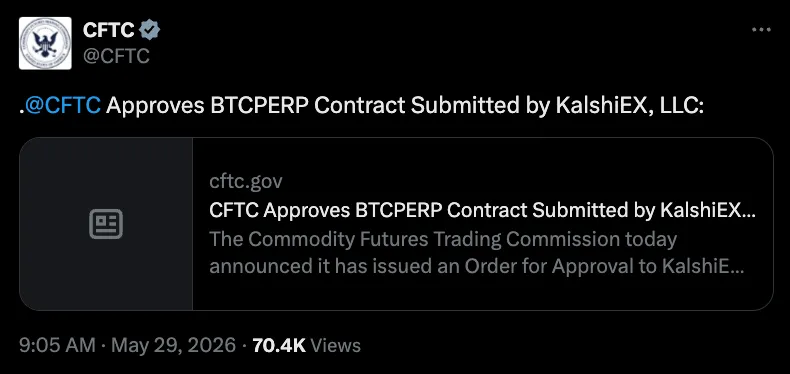
The US Commodity Futures Trading Commission approved perpetual futures contracts tied to the spot price of Bitcoin for prediction-markets platform Kalshi, while issuing a separate advisory affirming that crypto derivatives may be "well-suited for 24/7 trading, clearing, and settlement." Acting sole commissioner Michael Selig led the move, which Coinbase chief legal officer Paul Grewal called a "massive first" for the industry. The dual notices effectively pull perpetuals — a derivative product central to global crypto markets but long unavailable to US retail traders — inside the regulated American framework. Kalshi launched its  Bitcoin (BTC) contract the same day, with CME Group also signaling 24/7 crypto futures pending review.
Treasury Secretary Scott Bessent told the 2026 Reagan National Economic Forum that the US has seized roughly $1 billion in cryptocurrency from entities tied to Iran's military since hostilities erupted in February. "Just outright grabbed the wallets," Bessent said, adding that some holders "may be typing in right now" without realizing their funds are gone. The seizures reflect Washington's expanding crackdown on Tehran's revenue streams amid disrupted oil flows through the Strait of Hormuz, where roughly twenty percent of global crude transits. Bessent declined to specify whether Bitcoin accounted for the bulk of the recovered assets.
Celsius founder Alex Mashinsky filed a handwritten motion in the Southern District of New York seeking to vacate his twelve-year prison sentence for commodities and securities fraud. The petition argues his prior counsel — Mukasey & Young LLP — operated under an "unwaivable conflict of interest" stemming from the firm's separate engagement with FTX founder Sam Bankman-Fried. Mashinsky contends that conflict shaped every strategic decision in his defense and that alleged market manipulation of the CEL token and stETH by SBF was a root cause of Celsius's collapse. He pleaded guilty last year to defrauding customers of approximately $42 million.

The stablecoin yield dispute now consuming Washington traces directly to last summer's GENIUS Act, signed by President Donald Trump in July 2025. That statute prohibits stablecoin issuers such as Tether and Circle from paying interest to clients but leaves the door open for third-party platforms — exchanges, custodians, and brokers — to do so. Banks have lobbied to close that loophole through the Clarity Act, arguing yield-bearing stablecoins siphon deposits out of the regulated banking system and into DeFi-adjacent products. Crypto firms counter that yield is a core competitive feature, setting up the deadlock Dimon has now publicly embraced.
Iran's pivot to digital assets shows how state actors are repurposing public blockchain rails to evade Western sanctions. The Islamic Revolutionary Guard Corps has reportedly backed Hormuz Safe, a Bitcoin-settled maritime insurance platform, while a separate plan would compel oil tankers transiting the strategic waterway to pay transit fees in Bitcoin (BTC). An Iranian official quoted earlier this year argued such payments "can't be traced or confiscated due to sanctions" — a claim Bessent's $1 billion seizure figure directly contradicts. Israeli authorities previously alleged Iran-linked actors had also routed funds through Tether's USDT stablecoin to bypass traditional dollar rails.

Friday's developments converge on a single theme: digital assets have moved from the regulatory fringe to the center of policy, finance, and geopolitics. The Dimon-Armstrong clash represents an existential lobbying war over who captures stablecoin economics. The CFTC's perpetuals approval signals US derivatives infrastructure is bending toward crypto market structure rather than the reverse. Bessent's seizure disclosure demonstrates how sovereigns now weaponize on-chain transparency against adversaries. And Mashinsky's appeal closes a chapter on the 2022 collapse cycle that birthed today's regulatory architecture. Each story is a distinct facet of crypto's institutional inflection point — and none of these altcoin-era debates are going away.
AI-generated, AI-reviewed, under COINOTAG editorial oversight.