

Ethereum Outperformance Eyed at 40%, Movement Pivots to $685B Payments Market
Movement pivots to stablecoin payments targeting the $685B remittance market as StanChart's Kendrick forecasts 40% ETH outperformance versus bitcoin.
The team behind Movement, originally conceived as a bridge between Move-language blockchains and Ethereum, has announced a sharp strategic reorientation toward cross-border payments, remittances and dollar savings products. The project said Tuesday it has secured access to licensed payment systems across the United States, Canada and European Union, positioning stablecoin-based settlement infrastructure as its new growth vector. CEO Torab Torabi framed the shift as a mission to "marry licensed payment rails with onchain settlement" for emerging markets, where billions remain financially underserved. The pivot targets the roughly $685 billion remittance corridor serving low and middle-income economies, a market Movement now sees as more defensible than crowded scaling chains.
Movement's reorientation reflects a broader recalibration sweeping the Ethereum scaling sector. Dozens of layer-2 networks once pitched as the answer to Ethereum's congestion are now competing for a finite pool of users, liquidity and developer mindshare, with rollup technology rapidly commoditizing. Polygon, one of the earliest scaling projects, has spent recent years repositioning around payments, stablecoin rails and fintech partnerships rather than raw throughput metrics. The shift marks a maturation point where blockchain networks increasingly compete with traditional financial infrastructure rather than each other. For projects struggling to differentiate purely on technical specs, real-world payments offer measurable revenue and a clearer narrative for institutional partners and regulators alike.

As part of the restructuring, the Movement Network Foundation disclosed it had repurchased roughly 19% of the tokens previously allocated to early investors, equivalent to about 4.1% of the total MOVE supply. The buyback represents a meaningful adjustment to the project's circulating supply dynamics and signals an attempt to consolidate governance around the new operational mandate. MOVE was changing hands around 14.35 cents at the time of the announcement, leaving the token well below earlier valuations. Treasury actions of this scale are increasingly used by foundations to reassure communities that early-investor overhangs are being reduced as projects redirect resources toward execution rather than speculative tokenomics.
Standard Chartered's head of digital asset research Geoff Kendrick told clients that Strategy's first bitcoin sale since 2022 may mark the beginning of sustained ether outperformance versus bitcoin. While the disposal itself was small relative to the firm's roughly $58 billion BTC stack, Kendrick argued the market's reaction was telling — ether rose roughly 5% against bitcoin in the sessions that followed, one of the sharpest ETH-versus-BTC moves on a down day for crypto since the start of 2024. Kendrick reiterated long-term ether price targets of $4,000 by year-end 2026 and $40,000 by 2030, framing the recent rotation as the opening of a structural shift.
The strategist now expects the ETH-BTC ratio to climb toward 0.04 by year-end, up from roughly 0.028 today, an implied 40% outperformance regardless of broader direction. Ether has trailed bitcoin by 66% since Ethereum's September 2022 transition from proof-of-work to a proof-of-stake consensus mechanism, bottoming at a five-year low against BTC in April 2025 before rallying more than 60% off those depths. The recovery has rekindled debate over whether ether can sustain leadership through the rest of the cycle, particularly as anticipated U.S. regulatory clarity unlocks new institutional flows into staking, decentralized finance and tokenized assets that disproportionately favor the Ethereum stack.
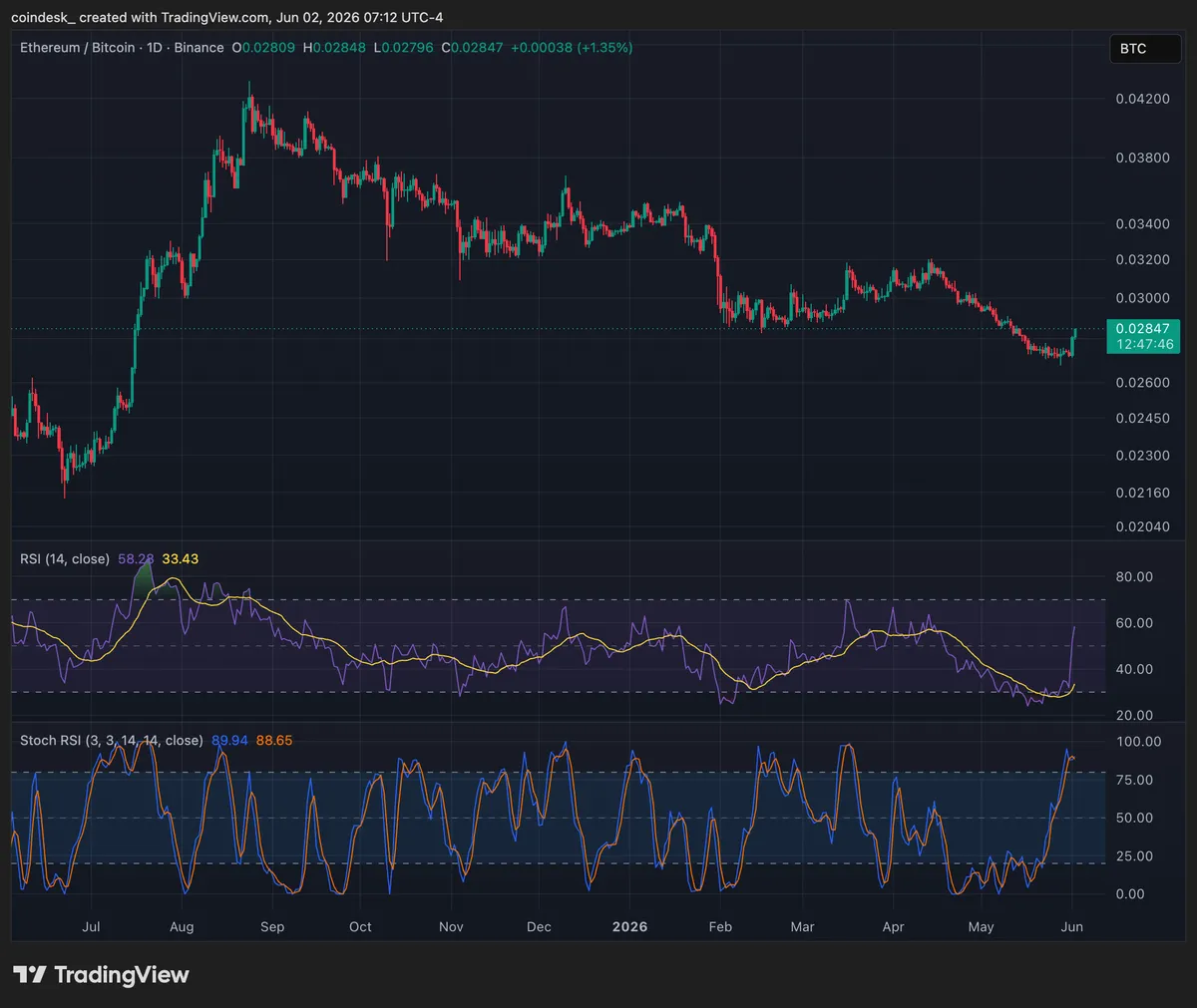
Kendrick's deeper argument centers on the divergent economics of bitcoin and ether treasury vehicles. Strategy and similar bitcoin-focused corporate holders depend almost entirely on BTC price appreciation and capital-markets activity to finance accumulation, leaving them vulnerable when prices stall and refinancing windows tighten. Ether treasuries, by contrast, can generate native yield through staking, giving them an income stream that does not require selling tokens to service obligations. That structural difference, the analyst suggested, could become more visible if other large bitcoin holders follow Strategy in trimming exposure to cover liabilities, with proceeds and incremental allocations potentially rotating into ether-denominated balance-sheet strategies.
Ether is trading near $1,974 with a flat 24-hour print, but the broader tape remains in a clear downtrend. The 14-day RSI at 29.01 sits in deeply oversold territory while the MACD continues to flash a bearish crossover, pointing to weakening momentum even as price stabilizes. Immediate resistance stacks at $1,981, $2,023 and $2,063, with bulls needing to reclaim the $2,063 shelf to invalidate the downside thesis. On the downside, support sits at $1,939, $1,876 and the psychological $1,800 mark. A clean break below $1,800 would cancel the oversold-bounce setup and open a deeper retrace toward the next demand zone.
Related Tags
AI-generated, AI-reviewed, under COINOTAG editorial oversight.