

Keyrock Buys BlockFills for $3.25M, Anchorage Launches CMS Settlement Network
Keyrock acquires BlockFills out of Chapter 11 for $3.25M while Anchorage Digital launches CMS settlement network for institutional crypto trading.
Brussels-based digital asset firm Keyrock is set to acquire crypto trading and lending platform BlockFills out of Chapter 11 bankruptcy, with a court hearing scheduled for June 16, 2026. The transaction values BlockFills at $3.25 million and includes substantially all of the firm's assets, customer lists, proprietary technology and intellectual property. BlockFills, operated by Reliz Ltd., filed for Chapter 11 protection on March 15 in the U.S. Bankruptcy Court for the District of Delaware, reporting assets between $50 million and $100 million against liabilities of $100 million to $500 million. Keyrock was declared the 'Successful Bidder' for the affiliated debtors in a May 26 court filing.
Anchorage Digital separately rolled out its Coordinated Multiparty Settlement platform, or CMS, designed to let institutional traders execute on crypto venues while assets remain in custody at the firm's federally chartered bank. The system links trading venues, prime brokers and end clients through a shared settlement layer, verifying funding obligations and reducing the number of asset transfers required to complete trades. The architecture aims to eliminate pre-funded exchange accounts — a common source of counterparty and operational risk in current market structure. Under the model, prime brokers manage client balances and credit, venues act as matching engines, and Anchorage handles custody and settlement end-to-end.
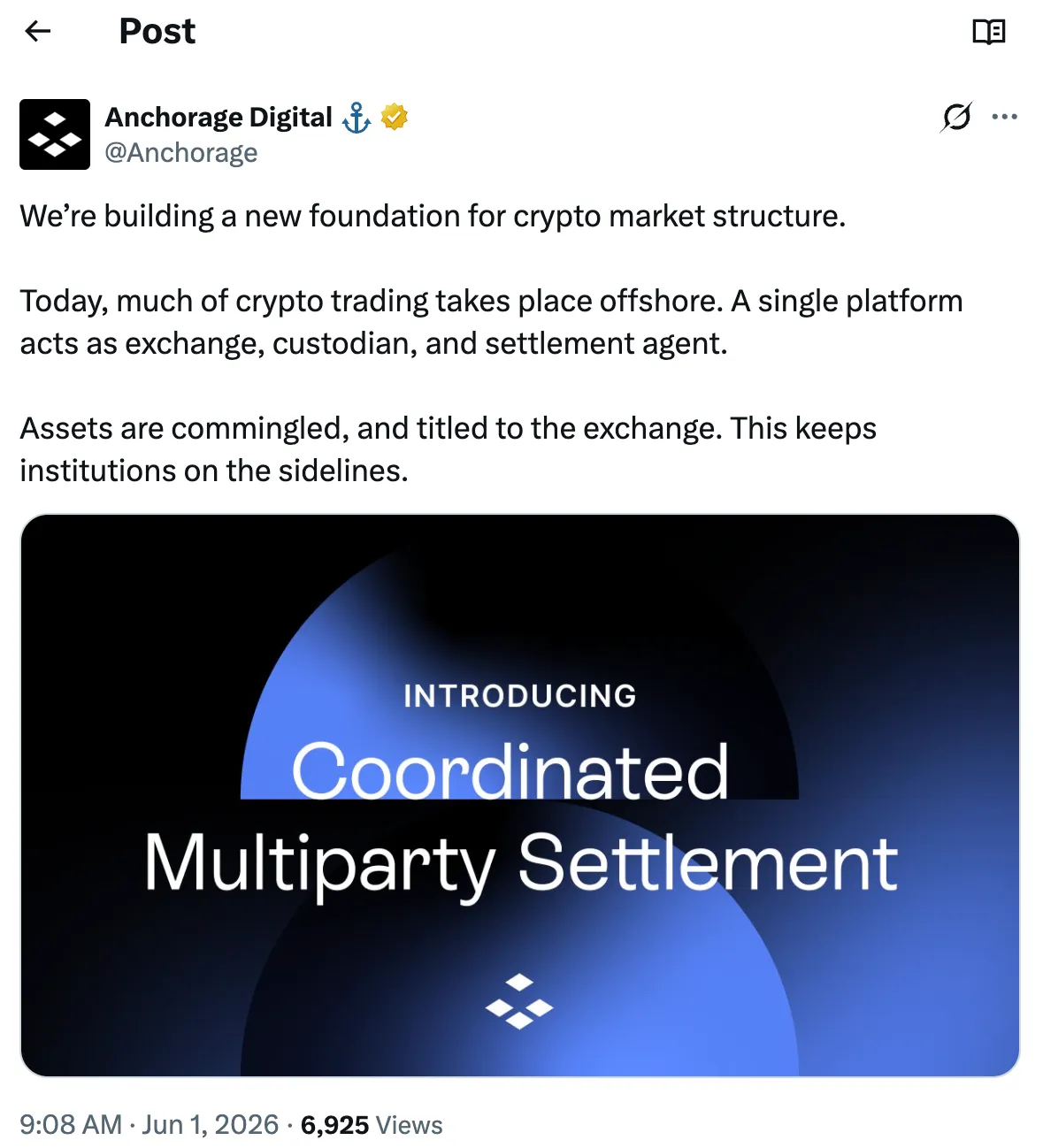
The first venue integration for CMS will be Spotex, a foreign exchange trading platform that processes billions of dollars in daily volume, with additional partners under development. Anchorage framed the launch as a direct response to offshore venues where a single operator typically serves as exchange, custodian and settlement agent — with client balances commingled and titled to the platform. By separating those functions across regulated intermediaries, the design more closely mirrors how settlement works in traditional securities markets, an approach absent from most centralized crypto exchanges and inverted from how a decentralized exchange (DEX) handles user assets on-chain.
Wider tokenization efforts on regulated infrastructure continue to accelerate alongside settlement initiatives. The Depository Trust & Clearing Corporation last December teamed with Digital Asset and the Canton Network to support the tokenization of DTC-custodied U.S. Treasury securities, with plans to expand the scope to additional asset classes. The Canton Network has emerged as a preferred venue for institutional experimentation because of its permissioning model, which lets regulated participants transact on a public blockchain while preserving privacy at the transaction level. Treasury tokenization in particular is viewed as the gateway use case for bringing trillions in collateral on-chain.
Earlier this year, digital asset custodian Fireblocks integrated the Canton Network, enabling banks, custodians and asset managers to custody and settle tokenized assets on a blockchain purpose-built for regulated financial markets. The integration extends Canton's reach into a custody platform already used by hundreds of institutional clients, lowering the technical bar for legacy financial firms experimenting with on-chain workflows. Market participants view such integrations as critical to the broader institutional thesis: that tokenization can compress settlement cycles, reduce reconciliation overhead and unlock capital efficiency — provided the underlying rails meet existing compliance, custody and risk-management standards applied to Bitcoin and other asset classes.

Banks themselves continue to deepen their crypto infrastructure footprint. In May, Standard Chartered agreed to acquire Zodia Custody outright while spinning out Zodia Solutions as a separate institutional digital asset platform. The transaction consolidates the bank's cold wallet custody operations under a single entity while creating a standalone company focused on broader institutional services. The move follows a wave of bank-led acquisitions and joint ventures targeting tokenization, custody and settlement capabilities — areas regulators have increasingly signaled are appropriate for chartered institutions to operate in. Standard Chartered's deal underlines that the largest global banks now treat digital asset infrastructure as core, not adjacent, business.
Taken together, the week's developments point to a single thematic arc: institutional crypto infrastructure is consolidating around regulated custody, multi-party settlement and tokenized collateral. Distressed firms are being absorbed by better-capitalized peers, settlement networks are being built to isolate counterparty risk, and traditional financial-market plumbing is being reproduced on-chain through permissioned blockchain networks. Rather than the speculative retail-driven cycles that defined earlier phases — including the rise of unregulated DeFi lending — the current build-out emphasizes balance-sheet trust, compliance compatibility and capital efficiency. The center of gravity continues to shift toward chartered banks and regulated market utilities.
AI-generated, AI-reviewed, under COINOTAG editorial oversight.