

Liquid Lane Targets $33B RWA Redemptions; DAT Inflows Plunge 95% to $180M in May
Symbiotic's Liquid Lane attacks the $33B RWA redemption bottleneck as digital asset treasury inflows plunge 95% to $180M in May, signaling sector maturity.


Symbiotic, a crypto infrastructure firm backed by Paradigm, Pantera Capital and Coinbase Ventures, unveiled Liquid Lane, a system designed to attack one of the biggest barriers facing tokenized assets: redemption liquidity. The product lets investors swap tokenized funds, private credit instruments and other real-world assets for stablecoins almost instantly, replacing redemption windows that can stretch as long as 180 days. Cofounder Misha Putiatin said the broader RWA market has crossed $33 billion, yet most assets still cannot be redeemed on demand — a friction point that pushes institutional investors to price liquidity at a premium and constrains growth across tokenized credit and fund products built on public blockchain rails.
Liquid Lane introduces a market-based redemption model that routes exit requests through a request-for-quote system connecting verified market makers. Participants compete to provide instant USDC liquidity, delivering stablecoins to the seller while taking on the tokenized position, with the issuer completing settlement asynchronously in the background. Unlike isolated liquidity pools, the system relies on shared collateral that can support multiple issuers simultaneously while earning redemption spreads and lending income from protocols such as Aave and Morpho. Fasanara Capital, manager of the tokenized credit fund mGLOBAL, will serve as the first vault curator alongside Avantgarde Finance, Barter and KPK, with Midas integrated as the launch issuer.

The launch arrives as projections for tokenized finance continue to climb. Citi has estimated tokenized assets could reach a $5 trillion market by 2030, while joint forecasts from BCG and Ripple peg the figure closer to $19 trillion by 2033, underscoring how aggressively traditional finance is pricing in the migration of bonds, credit and fund exposure onto public ledgers. Practitioners argue that scale will remain capped until the redemption layer matches the speed of onchain transfer. RedStone Settle will connect Liquid Lane to lending market liquidations, a step intended to extend tokenized-asset utility into broader DeFi credit infrastructure rather than confining RWAs to passive ownership.
Monthly inflows into digital asset treasury (DAT) companies collapsed to $180 million in May, the weakest reading since October 2024 and a 95% drop from April's $4.4 billion. The figure also sits roughly 93% below the average monthly intake recorded from January through May, ending a two-month streak in which DAT vehicles absorbed $4.2 billion in March and $4.4 billion in April. Bitcoin-focused treasury firms accounted for $177 million — about 98% of the total — with marginal flows into ZCash, Story and Sui, while Litecoin treasuries posted a $1.89 million outflow as appetite for smaller altcoin exposures cooled sharply.
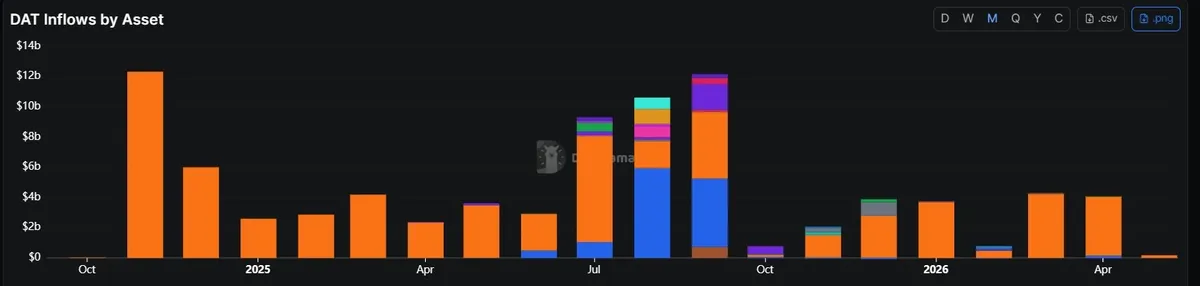
Industry analysts argue that DAT companies now face a higher bar from investors following the 2025 boom. Galaxy Digital has stated the raise-and-hold era is effectively over, urging treasury firms to deploy assets through staking, validator infrastructure or decentralized finance strategies rather than relying on passive accumulation. Staking infrastructure provider Everstake reinforced the view on May 26, noting that Ether treasury companies are under pressure to generate revenue as spot ETFs weaken the case for vehicles that simply hold ETH. A review of six treasury firms disclosing staking-related income found yield tied to the consensus mechanism accounted for roughly 60% of their reported revenue.
Beyond the staking debate, net asset value compression and dilution risk are driving the repricing. Mercuryo chief business officer Arthur Firstov pushed back on the idea that exchange-traded funds alone explain the cooling, pointing instead to a combination of ETF competition, premium contraction and the persistent need for treasury companies to justify trading above net asset value. Many DAT vehicles raised capital through equity issuance during the boom, leaving newer investors exposed when premiums to underlying token holdings shrink. The pattern suggests passive crypto treasuries — once a popular proxy for spot exposure — are being forced to evolve into yield-generating operating businesses to survive.
Together, the two developments mark a structural shift in how capital enters and exits crypto. On one side, tokenization is moving past representation into utility, with infrastructure like Liquid Lane attacking the redemption bottleneck that has kept institutions cautious. On the other, the passive treasury model that dominated 2025 is giving way to investor expectations around yield, NAV discipline and operational productivity. The unifying theme is maturity: institutional capital is no longer satisfied with mere onchain exposure and now demands the same liquidity, transparency and return profile it expects from established traditional financial products.
AI-generated, AI-reviewed, under COINOTAG editorial oversight.