

Poland Adopts MiCA Crypto Bill, South Korea Targets Tokenized Securities, Hana Buys $668M Upbit Stake
Poland adopts MiCA crypto bill 241-200, South Korea targets July tokenized securities rules, Hana Financial buys 6.55% Upbit operator stake for $668M.
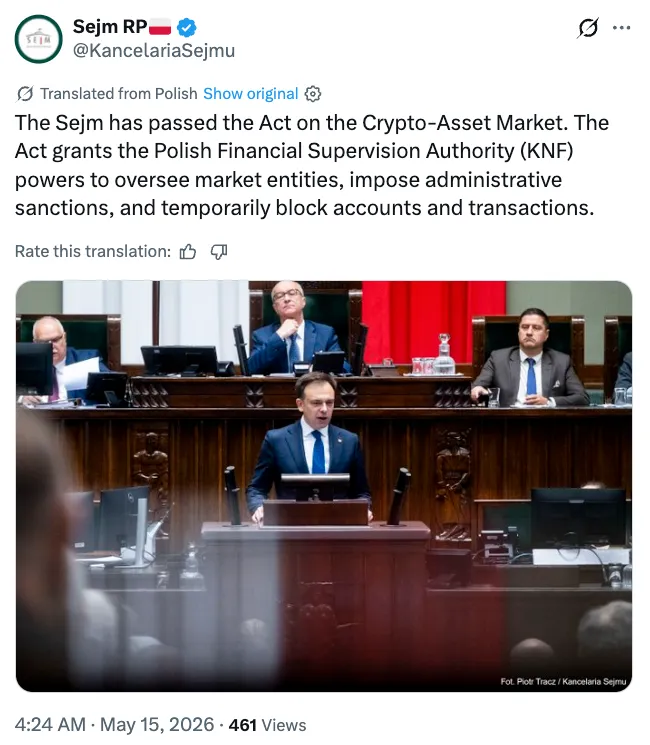
Polish lawmakers passed a government-backed crypto regulation bill on Friday, advancing the country's alignment with the European Union's Markets in Crypto-Assets framework after two prior presidential vetoes derailed earlier attempts. The Sejm adopted the legislation in a 241-200 vote during its 57th sitting, granting the Polish Financial Supervision Authority sweeping powers to supervise market participants, levy administrative sanctions, and temporarily freeze accounts and transactions. The push gains urgency from a deepening probe into collapsed exchange Zondacrypto, where estimated user losses exceed 350 million zlotys, roughly $96 million. Critics warn President Karol Nawrocki may again veto provisions on account and domain blocking, leaving Poland's blockchain sector in regulatory limbo.
South Korea's Financial Services Commission confirmed plans to release detailed tokenized securities rules in July, setting the stage for the country's first regulated framework covering blockchain-issued stocks, bonds, and money market funds before full implementation on February 4, 2027. FSC Vice Chairman Kwon Dae-young said the package will establish a roadmap for tokenizing capital market instruments, revise over-the-counter trading limits, and permit pooling of similar underlying assets in fractional investment products. The framework, anchored in amended Capital Markets and Electronic Securities Acts, will legally recognize distributed ledgers as valid securities registries and bring tokenized assets directly under FSC jurisdiction, ending their experimental status.
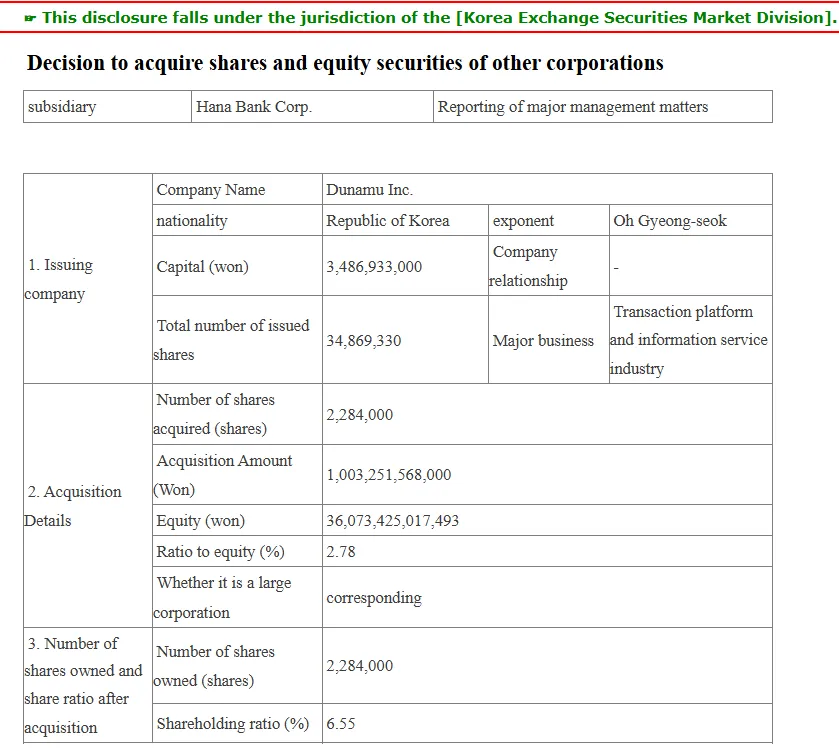
Hana Financial Group is acquiring a 6.55% stake in Dunamu, operator of South Korean exchange Upbit, in a deal worth more than 1.003 trillion won, roughly $668 million. The conglomerate is purchasing over 2.2 million shares from Kakao Investment, making it Dunamu's fourth-largest shareholder behind chairman Song Chi-hyung, Vice Chairman Kim Hyoung-nyon, and Kakao. Hana described the move as a play for strategic equity in next-generation finance, while Kakao said it would retain 1.4 million shares and redeploy proceeds toward future investments. The transaction extends Hana's previous April pact with Dunamu and POSCO International to develop a blockchain remittance corridor.
Global exchange OKX is reportedly negotiating with Korea Investment & Securities to take parallel 20% stakes in Coinone, each side acquiring shares primarily through fresh issuance rather than secondary sales. The proposed structure would inject capital into one of South Korea's five licensed won-trading venues without immediately disturbing management control. The talks emerge against a tightening regulatory backdrop: on April 13, authorities fined Coinone roughly $3.5 million and ordered a three-month partial business suspension over deficient customer verification and dealings with unregistered overseas exchanges. Coinbase reportedly weighed a similar investment earlier this year but never finalized a deal with the won-denominated exchange operator.
Australia's Labor government unveiled capital gains tax reforms inside its FY2027 budget that would impose a minimum 30% rate on capital gains and eliminate the 50% discount for assets held longer than 12 months. Industry executives warn the changes hit retail crypto investors hardest: a lower-income trader who previously paid roughly $3,800 on a $20,000 discounted gain would owe approximately $10,200 under the new regime, nearly triple the prior bill. Analysts argue the removal of the hodl incentive could push altcoin participants toward shorter holding periods and more active trading, fundamentally reshaping behavior in a market that already trades around the clock.
Crypto data platform Dune cut 25% of its workforce, with co-founder Fredrik Haga framing the layoffs as a pivot toward artificial intelligence tooling and institutional adoption. Haga highlighted Dune MCP, a product designed to let users build dashboards without SQL or data infrastructure expertise, as central to the refocus. The reduction follows a March hiring drive of 300 interviews where AI fluency was a non-negotiable bar. Dune joins a broader wave of crypto sector restructuring: Coinbase recently announced a 14% headcount reduction toward an AI-first operating model, while Algorand Foundation cut 25% in March and Gemini trimmed the same share in February while exiting several markets.

The dominant thread tying these developments is the rapid institutionalization of crypto across both regulatory perimeters and corporate balance sheets. Europe and South Korea are racing to lock the asset class inside formal capital markets law via MiCA transposition and tokenized securities frameworks, while traditional financial conglomerates such as Hana Financial and Korea Investment & Securities are buying their way into licensed exchange infrastructure. Australia's tax reset signals governments are equally focused on revenue capture, treating Bitcoin and digital assets like any other taxable instrument. Even firms born native to DeFi are restructuring around institutional clients, confirming that the cycle's center of gravity has decisively shifted toward regulated, professionalized capital.
Related Tags
AI-generated, AI-reviewed, under COINOTAG editorial oversight.