

Schwab Plans 2027 Advisor Crypto, Kraken and Ledger Delay IPOs, Movement Pivots to L1
Schwab targets 2027 advisor crypto launch threatening Coinbase Prime as Kraken, Ledger, Consensys delay IPOs and Movement relaunches as a Layer 1.
Movement, the once-troubled Ethereum scaling project that suffered a token-dumping scandal shortly after launch last year, has rebooted as a standalone Layer 1 blockchain aimed at stablecoin settlement in emerging markets. Move Industries chief executive Torab Torabi confirmed the firm has secured licensed payment rails across the United States, Canada, and the European Union through partnerships with regulated money transmitters and e-money institutions. Circle, wallet startups KAST and Sorted, and tokenization projects Oro, Yuzu Money, and Zoth are among the launch partners. The team is also targeting sub-500 millisecond settlement on a dedicated validator set, dropping the legacy data-availability dependencies that produced seven-second latency on the prior Layer 2 design.
Charles Schwab is preparing a mid-2027 launch of spot crypto trading, transfers, and custody for the 16,000-plus registered investment advisors using its platform, a move that could route trillions of dollars in client assets through one integrated stack. Schwab Advisor Services already custodies more than $5 trillion for RIAs who currently send digital-asset allocations off-platform to specialized providers. The retail spot service rolled out earlier in 2026 leans on Paxos for sub-custody and execution, and the advisor product is expected to launch with Bitcoin and ether before expanding. The eighteen-month runway puts direct pressure on Coinbase Prime, which oversees roughly $330 billion in institutional assets, alongside BitGo and Anchorage.
Kraken parent Payward paused its US public listing preparations in March even after filing a confidential S-1 the prior November, joining a broader cluster of crypto firms walking back 2026 IPO ambitions. A secondary share sale to Deutsche Börse in April valued the exchange at $13.3 billion, roughly a third below the $20 billion mark set during its previous private round. The company also trimmed about 150 jobs while deploying new automation tools across its operations. Management has cited soft trading activity and weak crypto market conditions, with capital that historically rotated into exchange listings now being absorbed by an aggressive queue of artificial intelligence infrastructure deals.
Hardware wallet maker Ledger followed a similar path in mid-May, scrapping its planned US listing without ever submitting an S-1 and opting instead for a $50 million private share sale. The company had previously targeted a valuation above $4 billion with banking syndicate work involving Goldman Sachs, Jefferies, and Barclays. The decision reflects the same demand-side problem facing the rest of the sector: institutional appetite for crypto-native equities is being crowded out by trillion-dollar technology listings led by SpaceX, Anthropic, and OpenAI. Without a robust public-market exit window, late-stage crypto names are increasingly choosing dilution-light private rounds over the risk of a discounted public debut.
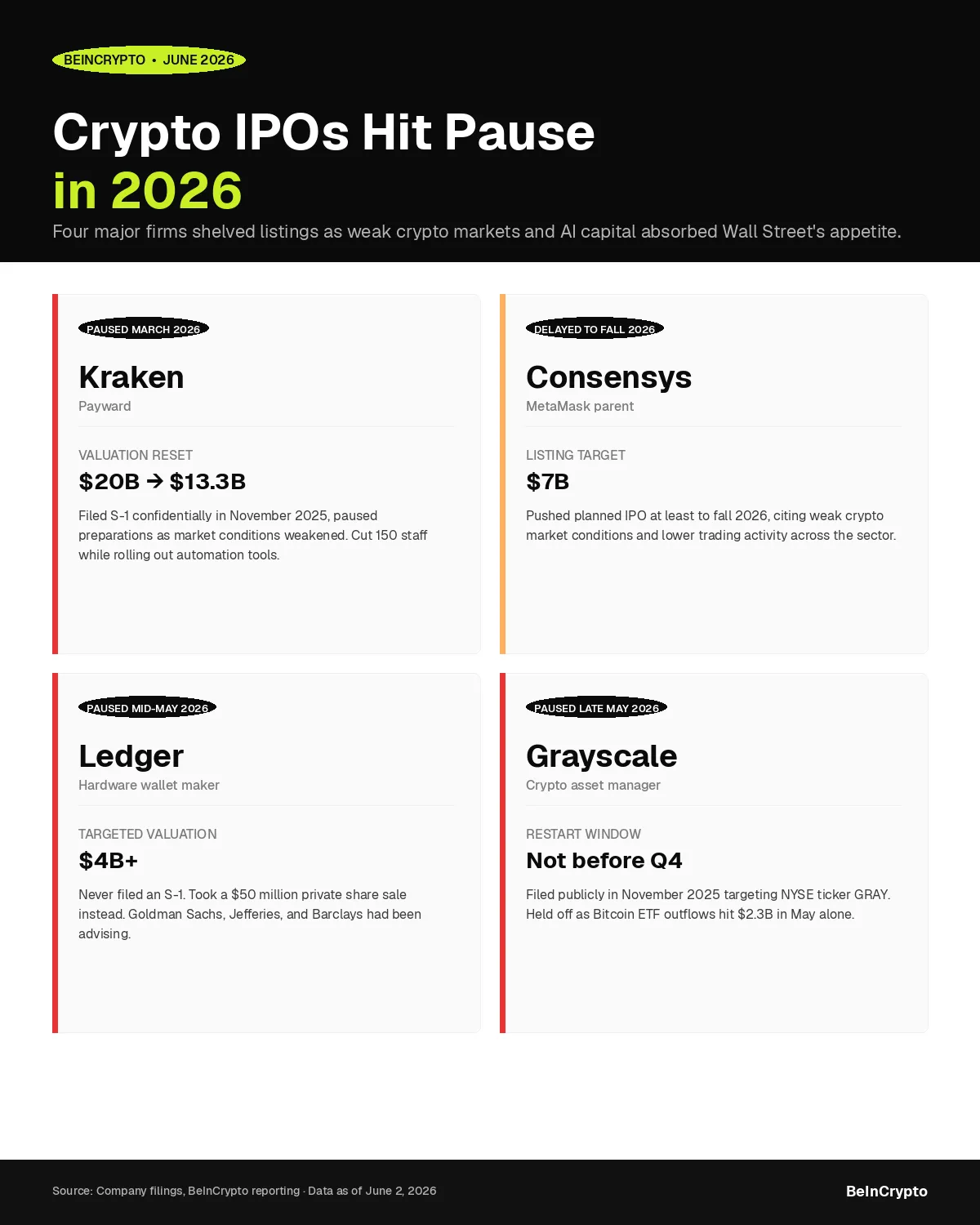
The Ethereum-focused infrastructure firm behind MetaMask, a wallet widely used to access DeFi protocols, has pushed its planned $7 billion Consensys listing back to at least fall 2026 after originally targeting the first half of the year. Grayscale paused its own IPO in late May despite a public filing in November 2025, with a restart unlikely before the fourth quarter. Blockchain.com, which confidentially filed in late May, is now testing a more conservative deal structure. Together these delays mean that the wave of marquee digital-asset issuers many bankers expected to define 2026 has effectively been pushed into 2027, reshaping the timing of secondary-market liquidity for late-stage employees and venture investors across the industry.
Only one significant crypto IPO has cleared the window so far this year. Custodian BitGo, whose institutional offering relies heavily on cold-wallet storage architecture, raised about $213 million at $18 per share on January 22, valuing the firm at roughly $2.08 billion above its filing range. The aftermarket has been brutal: shares fell nearly 22% on day two and have at times traded around 36% below the offer price, signaling that even priced deals are struggling to hold. The broader equity capital pool has rotated decisively toward AI infrastructure and chip suppliers, with allocators preferring concentrated exposure to compute build-outs over fragmented bets on exchanges, miners, and wallet providers during a soft trading tape.
A single thread connects these stories: capital is consolidating around platforms with the deepest distribution. Schwab is pulling crypto inside the wirehouse, AI mega-issuers are absorbing the IPO bid, and Movement is retreating from generalized block space toward a narrow stablecoin-payments wedge. Each move concedes that 2026 rewards verticalized stacks and incumbent reach rather than the open-permissionless ethos that defined the prior cycle. For founders, the strategic question is no longer how to raise on growth multiples but how to build defensible niches before larger financial institutions roll up the surface area. Distribution, not innovation alone, is the binding constraint this cycle.
AI-generated, AI-reviewed, under COINOTAG editorial oversight.