

Tom Lee Targets $250K ETH as Bitmine Holds 5.4M Coins, Standard Chartered Flags Breakout
Tom Lee projects ether at $250,000 as Bitmine holds 5.4M ETH and Standard Chartered's Kendrick flags ETH breakout vs BTC after Strategy's 32 BTC sale.
At the Proof of Talk conference in Paris, Fundstrat's head of research Tom Lee laid out a long-range case for ether reaching $250,000, framing current prices around $1,906 as "future optionality at a discount." Speaking in his capacity as chairman of Bitmine Immersion Technologies, Lee told attendees that the network is undergoing a structural shift the broader market is mispricing. He declined to attach a specific timeline to the $250,000 figure but argued the move represents roughly a 50-times multiple if tokenization and on-chain artificial intelligence dominate the next computing cycle. The remarks landed as Ethereum traded 6% lower over 24 hours.
Bitmine itself has become a textbook example of the corporate treasury thesis Lee is pitching. Recent disclosures show the firm added 111,942 ETH last week worth roughly $237 million, marking its largest single accumulation since December. That brings total holdings to nearly 5.4 million ether, or about 4.47% of the asset's circulating supply, a concentration without parallel in any other large-cap digital asset. Lee tied the equation directly to share price, arguing that if ether reaches $250,000, Bitmine stock would be worth $5,000 versus its current $18 — a position he characterized publicly as a "bargain" relative to underlying net asset value.

The fundamental driver behind Lee's projection is the migration of internet traffic toward automated machine systems that require instant settlement rails. He argued that as robotic agents take over a growing share of online activity, the legacy banking system cannot support machine-to-machine payments at the latency required. Blockchain infrastructure, by contrast, handles authentication, identity verification and value transfer in a single layer. Andreessen Horowitz partners have described this convergence as "the great unification." Under this framework, ether transitions from a speculative altcoin into the settlement currency for global compute, which Lee sees expanding into a multi-trillion-dollar addressable market over the coming decade.
A separate bullish framing emerged from Standard Chartered, where Geoffrey Kendrick, the bank's global head of digital assets research, told clients ether is entering an outperformance phase against bitcoin. Kendrick argued the catalyst was not a technical signal but a behavioral one: Strategy disclosed selling 32 BTC during the final week of May to fund preferred stock dividends, the firm's first bitcoin sale since 2022. Though the volume was symbolic at roughly $2.5 million against an 843,706 BTC treasury, Kendrick said the disclosure cracked the asymmetric "never sell" narrative that had supported MSTR's premium, exposing structural weaknesses bitcoin treasury vehicles cannot easily resolve.
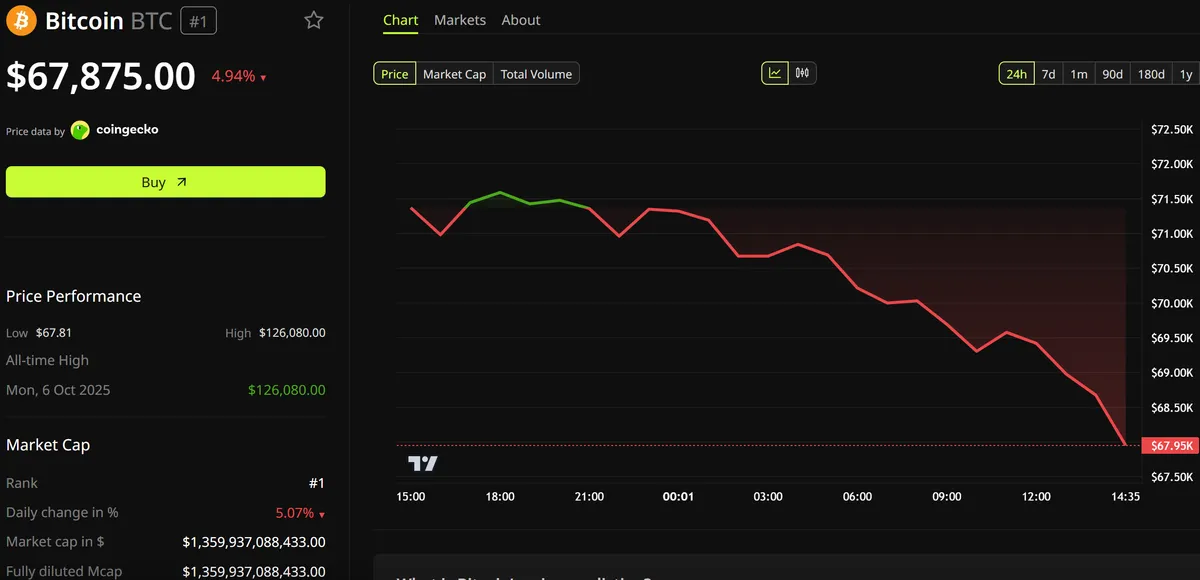
The structural asymmetry Kendrick highlighted centers on cash flow generation. Ethereum treasury vehicles can stake their holdings to validators and earn protocol-level yield denominated in ETH, providing operational funding without requiring spot sales. Bitcoin treasuries lack any equivalent native mechanism and must either dilute equity, issue convertible debt or sell coins to meet liabilities — the path Strategy chose. As corporate adoption of ether deepens, Kendrick projected the ETH/BTC ratio could climb materially through year-end. Bitcoin itself traded near $67,875, off nearly 5% in 24 hours, while market makers reported long-term funds accumulating in OTC tranches with $60,000 to $65,000 flagged as critical support.
A quieter governance shift is unfolding in parallel. The non-profit Ethereum Foundation has spent years systematically reducing its on-chain footprint, drawing down network holdings to a fraction of historical levels and ceding influence to publicly traded validators and staking aggregators. Lee framed this transition as institutional maturation, comparing it to how early-stage open protocols eventually pass into corporate stewardship. Critics counter that concentrated corporate validators could compromise the consensus mechanism's neutrality. Either way, validator-set composition is shifting toward balance-sheet operators with mandates that did not exist during the proof-of-work era, reshaping how protocol upgrades clear governance and how staking rewards are redistributed.
On-chain price action shows ether trading at $1,911 after a 4.1% drawdown, pushing the asset's RSI to 25.46 — firmly in oversold territory and historically a zone that precedes mean-reversion bounces, though not necessarily trend reversals. Immediate support sits at $1,874, with deeper backstops at $1,825 and $1,756. Resistance clusters at $1,941, $2,020 and $2,134. MACD remains bearish and the broader trend is negative, leaving the bullish thesis dependent on reclaiming $1,941 on volume. A breakdown below $1,756 would invalidate the constructive setup and open the path toward sub-$1,700 liquidity zones flagged by derivatives desks.
Related Tags
AI-generated, AI-reviewed, under COINOTAG editorial oversight.