

Treasury Sanctions Iran's Nobitex, EU-NY Forge Stablecoin Pact, Bitcoin Slides Under $66K
US Treasury sanctions Iran's Nobitex, EU-NY sign stablecoin MOU, Gate adds stocks via Alpaca, and Bitcoin slides below $66K on $1.64B liquidation cascade.
Gate has unveiled a strategic partnership with Alpaca to extend real stock trading to eligible users across its global platform, expanding well beyond its digital asset roots. The upcoming rollout will unlock access to more than 10,000 equities and ETFs listed on the New York Stock Exchange and Nasdaq, supporting fractional purchases starting at $1. Through Gate's unified account architecture, users will be able to deploy USDT directly to buy traditional securities, removing the friction of separate brokerage onboarding. Founded in 2013 and now serving over 54 million users, Gate is positioning the move as a decisive bridge between Bitcoin-native finance and regulated equities markets.

Franklin Templeton chief executive Jenny Johnson argued at the Proof of Talk summit in Paris that legacy financial institutions are stalling on public blockchain deployment because the technology directly cannibalizes their fee revenue. Running the firm's tokenized Benji money market fund on Stellar costs roughly $1.13 per transaction versus $1.30 on legacy rails, she said, citing internal data across 50,000 settlements. Johnson framed banks and brokers as transactional toll-takers whose margins evaporate when smart contracts handle clearing instantly. The $1.74 trillion asset manager is also expanding Benji distribution through a MoonPay integration aimed at institutional stablecoin flows.
The European Banking Authority and the New York State Department of Financial Services have signed a memorandum of understanding to jointly supervise cross-border stablecoin activity, marking one of the first formal transatlantic coordination frameworks for the asset class. The agreement falls under the EU's Markets in Crypto-Assets regime and will enable both regulators to share data on circulating supply, holder counts, audits, and product registrations. Officials said the pact aims to surface market risks earlier and harmonize crisis response. The global stablecoin sector has now eclipsed $319 billion in outstanding value, lifting regulatory urgency on both sides of the Atlantic.
Billions Network chief executive Evin McMullen warned that big tech and major telcos are confronting an existential collapse of their display-advertising business as autonomous AI agents replace human-driven search behavior. Speaking in Paris, McMullen said unidentified bots already account for more than 51% of online and on-chain activity, hollowing out the model of monetizing human attention. Her firm now supports the third-largest on-chain agent population behind Binance and Base, with cryptographic libraries deployed by over 9,000 corporate and sovereign developers, including TikTok and HSBC. The pitch: programmatic accountability layers built natively on blockchain rails.
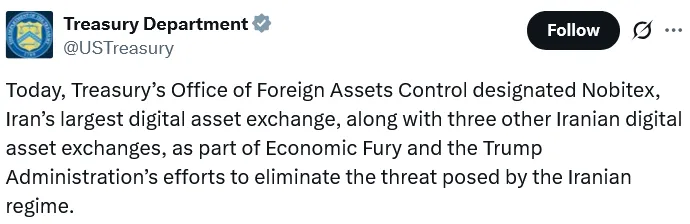
The US Treasury sanctioned four Iranian crypto exchanges, headlined by Nobitex, the country's largest venue, alongside Wallex, Bitpin, and Ramzinex. The designations under the Office of Foreign Assets Control prohibit US persons from providing services to the platforms and form the centerpiece of the Treasury's "Economic Fury" campaign launched on April 14. Treasury Secretary Scott Bessent said Nobitex handles roughly half of Iran's crypto trading volume and acts as a "digital dollar pipeline" for the Islamic Revolutionary Guard Corps. The move follows nearly $1 billion in crypto seizures from Iran-linked wallets since the conflict began earlier this year.
The broader crypto market extended losses, with total capitalization sliding 0.81% to $2.26 trillion after a 6.64% rout the prior session. Bitcoin dropped under $66,000 after MicroStrategy disclosed the sale of 32 BTC, its first divestment in 41 months, dragging MSTR stock down nearly 10%. Escalating US-Iran tensions amplified de-risking, triggering a $1.64 billion liquidation cascade in 24 hours, of which $1.47 billion came from long positions. Worldcoin sank 14% before bouncing, while Cardano slipped 6.5% to around $0.215 as founder Charles Hoskinson publicly criticized network governance amid ecosystem shutdowns.
The day's developments stitch together into a single thematic arc: state power is hardening around digital assets just as the architecture beneath them migrates onto public rails. Regulators in Washington and Brussels are simultaneously sanctioning hostile actors and codifying stablecoin oversight, while incumbents from Franklin Templeton to Gate concede that on-chain settlement is structurally cheaper and unavoidable. Layer in autonomous agents reshaping discovery and ad economics, and the legacy financial-and-information stack is being rewritten in parallel. Today's bear-market selloff is short-cycle noise; the deeper signal is a coordinated rotation toward regulated, programmable, geopolitically contested digital infrastructure.
Related Tags
AI-generated, AI-reviewed, under COINOTAG editorial oversight.