

April Hits 4-Year DeFi Hack Record as SEC Charges $12.3M AI Bot Fraud
April marked the worst DeFi exploit month in four years as the SEC charged a Texas operator with a $12.3M fake AI trading bot scheme targeting 150 investors.

Legacy financial institutions preparing to migrate trillions of dollars of assets onchain are stalling over an escalating security crisis, according to comments from CertiK chief executive Ronghui Gu. He framed the obstacle bluntly: bankers want the efficiency of decentralized ledgers, but the operational reality remains too risky for conservative capital allocators. AI-driven exploits, smart contract vulnerabilities, oracle manipulation, and cross-chain bridge attacks were cited as the primary blockers. Gu projected that within a decade, tens of trillions could shift onto public networks, but only once the blockchain security gap closes enough to satisfy compliance, custody, and audit requirements at the largest banks and asset managers.
The warning lands as April registered the worst month for DeFi security in four years, with exploits recorded on 27 of 30 days. CertiK attributes the spike to AI-powered attack engines that can run continuous vulnerability scans for days or weeks at marginal cost. A single attacker can deploy $10,000 to $20,000 in compute against a target protocol, while defenders operate under fixed project budgets across thousands of clients. The asymmetry, Gu argued, has turned protocol security into an "unfair game" tilted toward malicious actors, with infinite-resource adversaries probing high-TVL contracts around the clock.

Two of April's headline incidents were attributed to North Korean cyber units. Drift Protocol and Kelp Dao were exploited in coordinated operations that drained close to $600 million from the two lending pools combined. The attacks underscored how state-aligned actors continue to target DEX infrastructure and onchain lending venues with industrial-grade tradecraft. Forensic teams have linked Lazarus-affiliated wallets to a growing share of large-ticket thefts this cycle, with stolen funds typically funneled through mixers and cross-chain bridges before resurfacing on opaque OTC desks within hours of the initial breach.
The cumulative damage is staggering. On-chain data shows more than $1.1 billion has been lost to DeFi exploits over the trailing twelve months, with cross-chain bridges remaining the single most exploited attack surface. The February 2025 Bybit incident, which drained roughly $1.46 billion in Bitcoin and related assets, still stands as the largest single hack on record. Security analysts argue that until bridge architecture, multisig hygiene, and cold wallet custody standards converge across major venues, institutional rotation onchain will continue to encounter resistance from risk committees and underwriters.
Parallel to the security crisis, U.S. enforcement actions are intensifying. The Securities and Exchange Commission charged Nathan Fuller of Cypress, Texas with running a $12.3 million crypto fraud scheme that raised funds from roughly 150 investors. Operating through Privvy Investments LLC and the assumed name Gateway Digital Investments between October 2022 and mid-2024, Fuller allegedly promised returns of 40% to 50% within 30 to 45 days, with some investors told they could clear 100% in 21 days. He claimed funds were secured by a surety bond, FDIC insurance, and professional liability coverage. None of those representations were true, the complaint alleges.
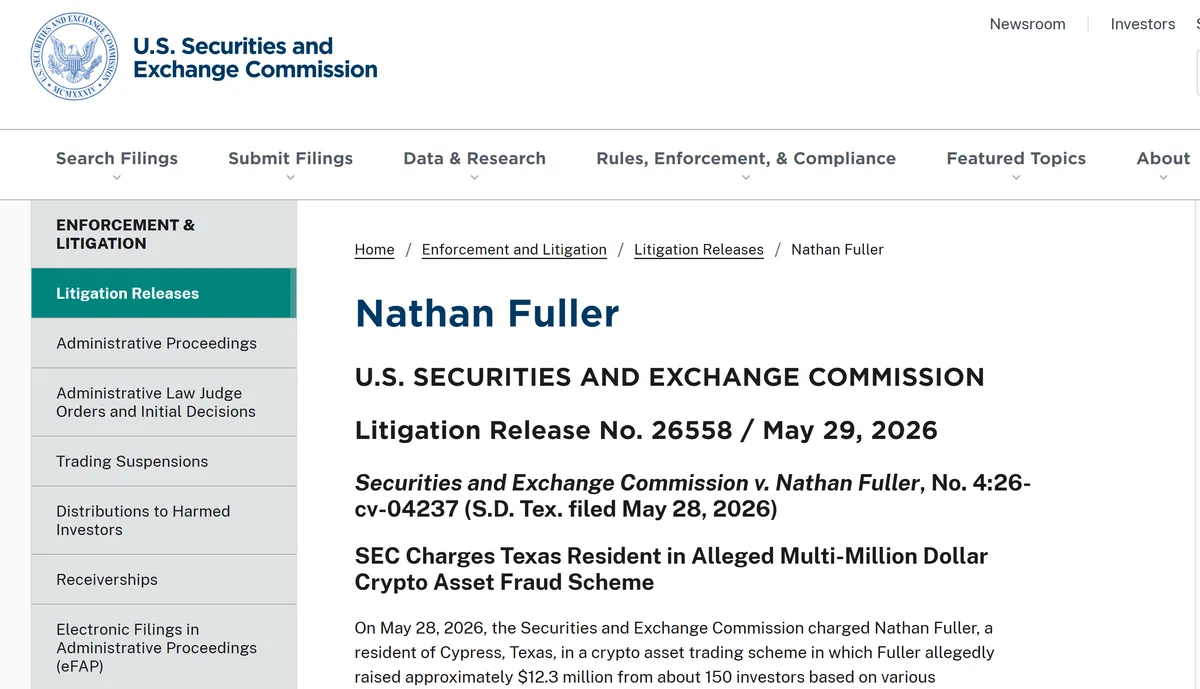
At the center of the pitch was a fictitious suite of proprietary AI trading bots marketed as high-frequency arbitrage engines operating across crypto platforms. Regulators allege the bots never functioned as represented. Of the $12.3 million raised, roughly $6.2 million was diverted to personal expenses and about $5.5 million was recycled to earlier investors in classic Ponzi fashion, supported by fabricated account statements and bogus correspondence from fictitious entities. The SEC is seeking permanent injunctions, disgorgement of ill-gotten gains, and civil penalties. The action follows last month's charges against crypto executive Donald Basile in a separate $16 million scheme.
Two narratives are colliding this cycle. On one side, AI is industrializing financial crime, compressing the cost of both protocol exploits and retail-investor fraud while enabling adversaries to scale faster than defenders or auditors can respond. On the other, regulators are leaning into traditional securities enforcement, treating AI-branded crypto products as the latest vehicle for unregistered offerings and misappropriation. The thematic arc connecting CertiK's institutional warning, the April exploit wave, and the SEC's fraud actions is the same: until security, custody, and disclosure standards mature, the trillion-dollar migration onchain will remain bottlenecked by trust, not technology.
Related Tags

AI-generated, AI-reviewed, under COINOTAG editorial oversight.