

Hoffman Exits Ethereum as Active Addresses Drop to 544K, Vitalik Pitches Options DeFi
Bankless co-founder Hoffman sells ETH amid active addresses collapse to 544K. Vitalik proposes options-based DeFi to curb cascade liquidations.


Bankless co-founder David Hoffman has sold his Ethereum holdings, declaring the long-running " Ethereum (ETH) is money" thesis fully played out. Hoffman framed the decision as a structural call rather than a tactical trade, arguing the network now routes value to layer-2s and applications instead of capturing it at the base layer. He remains constructive on Ethereum as infrastructure but sees no rerating ahead for the asset. Ether trades near $1,975, down 2.4% on the day and roughly 14% over the past month. The exit drew sharp reactions across the ecosystem, with some traders agreeing the thesis is exhausted and others viewing current levels as a discounted entry.
Ethereum co-founder Vitalik Buterin published a research proposal Monday outlining a redesign for how decentralized finance handles market crashes. Buterin suggested building index-tracking assets on top of options contracts rather than collateralized debt positions, the structure behind most synthetic assets and stablecoins today. The aim is to soften the abrupt liquidation cascades that amplify sell-offs during volatile stretches. Under the proposed framework, exposure would gradually diverge from a target allocation as prices move, replacing the binary "you get liquidated" event with a smoother adjustment. He argued the change would make protocols more resilient when collateral values collapse over minutes rather than hours.

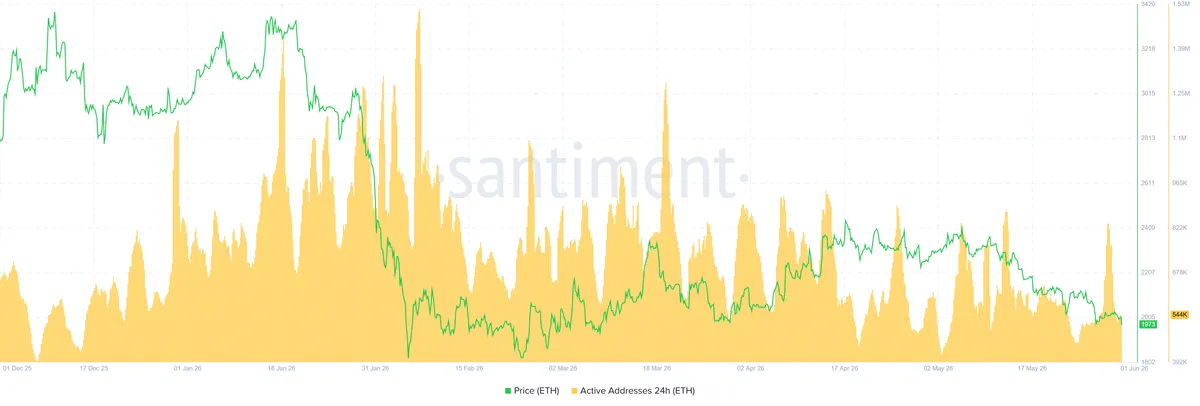
On-chain activity continues to weaken alongside the price decline. Daily active addresses on the network peaked above 1.5 million in January and have since fallen to roughly 544,000, a drop of more than 60 percent across the same window in which ether retraced from above $3,400 to under $2,000. Exchange balances are rising again, indicating tokens are being moved back to trading venues rather than held in wallets. The two signals together suggest fading retail and on-chain participation, a setup that historically precedes deeper drawdowns when fee-based revenue contracts. Demand metrics will need to stabilize before any sustained recovery in the spot price.
A key technical claim in Buterin's note centers on oracle design. Most current protocols depend on near real-time price feeds, which become attractive manipulation targets during turbulent sessions and can trigger faulty liquidations. An options-based framework, he argued, could operate using slower price feeds similar to those used in prediction markets, lowering the surface area for oracle attacks. The shift would reduce the need for split-second automated unwinding and could function safely even when underlying spot prices move rapidly. Buterin said he would feel materially safer holding algorithmic stablecoins built on this structure than ones reliant on tick-by-tick oracle updates that are routinely exploited.
Hoffman's exit note pointed to a structural pattern across layer-1 markets. Solana's 2024 rerating and NEAR's 2026 move both coincided with rising shares of total network fee revenue, reinforcing the view that base-layer token strength tracks fee market capture. He also referenced BNB and TRX, two of the highest-grossing chains, whose charts behaved consistently with that thesis. Ethereum (ETH), by contrast, surrendered fee market share across competing blockchain ecosystems through 2024 and 2025 as activity migrated to rollups and rival mainnets. The argument frames the current drawdown as a re-pricing of mainnet revenue rather than a temporary cyclical fade, raising the bar for what would constitute a credible reversal.
The options-based design carries particular relevance for algorithmic stablecoins, a sector that has produced repeated failures when collateral mechanisms snap under stress. Replacing instant liquidations with a gradual exposure drift could give protocols more room to absorb shocks before insolvency becomes a question. Buterin acknowledged the tradeoffs, including the need for regular portfolio rebalancing and additional complexity in matching contracts. The proposal sits at the research stage and would require deep liquidity in on-chain options markets to function at scale, a piece of infrastructure that remains thin compared with the lending and CDP venues that dominate today's stack.
Ether trades at $1,988 with a 24-hour decline of 0.85 percent and a market cap near $240 billion. RSI sits at 30.93, pressed into oversold territory, while the MACD signal remains bearish and the broader trend points down toward extended bear market conditions. Immediate support stacks at $1,956, $1,875, and $1,800, with resistance overhead at $2,003, $2,051, and $2,092. A reclaim of $2,003 with rising volume would be the first sign of stabilization, while a clean break below $1,956 opens the path toward $1,875. The bearish thesis is invalidated only on a daily close above $2,092 with confirming on-chain demand recovery.
AI-generated, AI-reviewed, under COINOTAG editorial oversight.